Notable figure
AL CAPONE, The Chicago’s Prohibition Kingpin
From Brooklyn street gangs to the heights of Chicago’s underworld, Al Capone became the most notorious gangster of the Prohibition era. Discover how he built his empire, and how federal investigators finally brought him down.
Identity
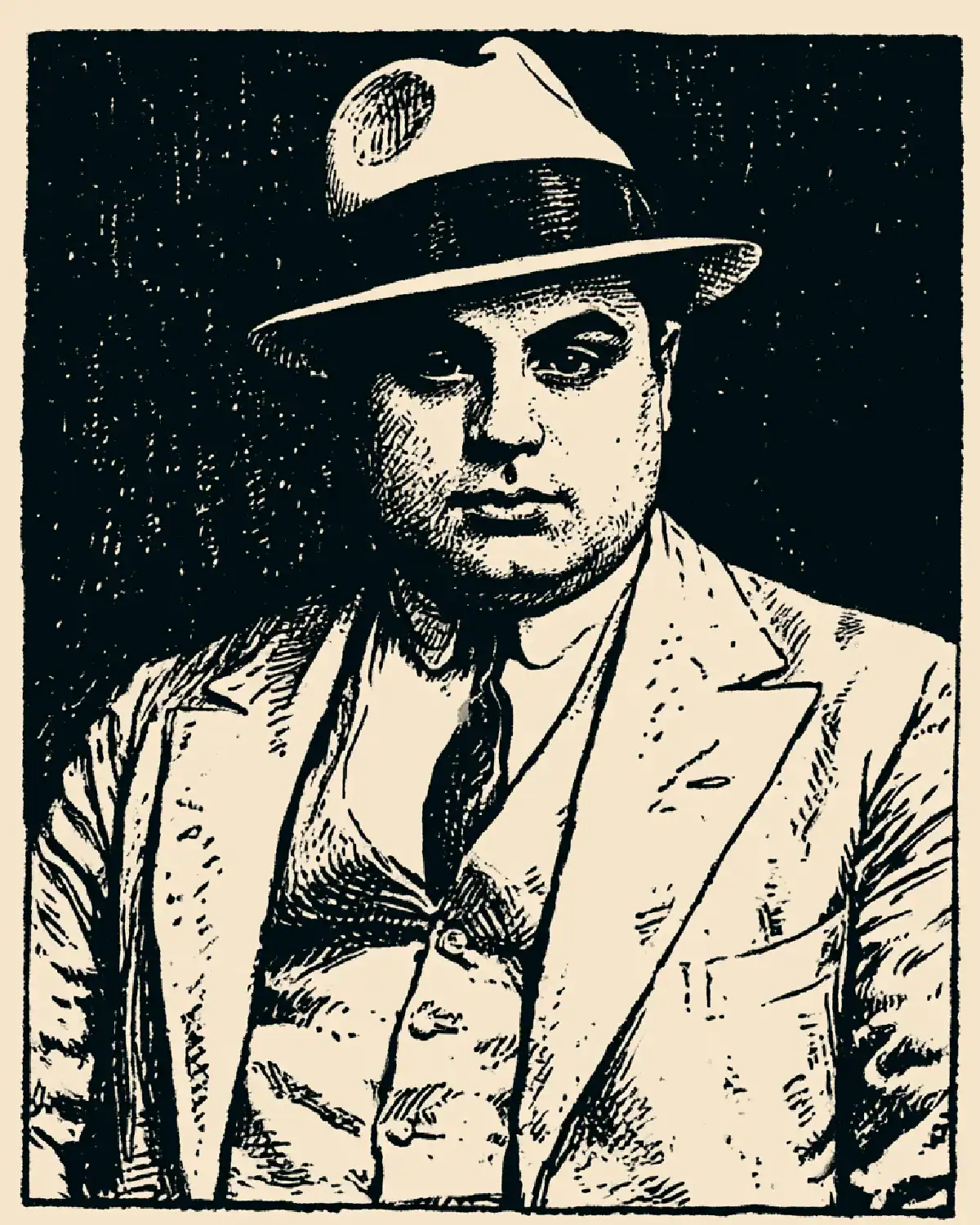
- Full name
- AL CAPONE
- Nickname
- Scarface
- Born
- January 17, 1899 — Brooklyn, New York
- Died
- January 25, 1947 — Palm Island, Florida
- Occupation
- Bootlegger and crime boss
Key dates
- 1899 Born in Brooklyn, New York
- 1920 Moves to Chicago
- 1925 Takes control of Johnny Torrio’s organization
- 1929 St. Valentine’s Day Massacre
- 1931 Convicted of federal income-tax evasion
- 1934 Transferred to Alcatraz
- 1939 Released from prison
- 1947 Dies in Palm Island, Florida
The Rise of Chicago’s Kingpin
Born in 1899 in New York City to Italian immigrant parents, Al Capone grew up in the working-class neighborhoods of Brooklyn. He left school at an early age and became involved with street gangs active in parts of the city. His ambition and attraction to easy money soon drew him deeper into the criminal underworld. It was also during these years that he acquired the nickname “Scarface” after his face was slashed during an altercation.
In the early 1920s, Capone left New York for Chicago, where he joined Johnny Torrio, one of the city’s leading organized-crime figures. Chicago was booming and offered fertile ground for illegal businesses. Under Torrio’s protection, the young gangster learned how to manage complex criminal operations, from gambling establishments to illicit drinking venues.
Capone’s rise accelerated amid a series of clashes between rival gangs. In 1925, Johnny Torrio was seriously wounded in an assassination attempt and decided to step away. At just 26, Capone took control of an already powerful criminal organization. With a keen sense for business and a commanding personality, he quickly consolidated his influence over a large share of Chicago’s illegal activities.
To secure his influence, Capone relied on intimidation, corruption and violence. Connections with some politicians and police officers helped shield his businesses and frustrate investigations. At the same time, he cultivated a public image as a generous man with ties to working-class communities.
By the end of the 1920s, Al Capone had become the dominant figure in Chicago’s criminal underworld. His name was known across the United States and his fortune continued to grow. His spectacular ascent made him one of the defining figures of American organized crime and earned him a reputation as Chicago’s underworld kingpin.
The Prohibition Empire
An underground empire
$100 million
in estimated annual revenue
At its height, Capone’s organization generated enormous revenues from bootlegging, gambling and other illicit businesses.
The onset of nationwide Prohibition in 1920 opened the door to an enormous underground market.
The manufacture, sale and transportation of intoxicating liquor were prohibited, but public demand remained strong. Capone quickly understood the opportunity created by that contradiction.
Capone used this trade to build a vast criminal empire. His organization controlled numerous illegal drinking establishments, known as speakeasies, along with clandestine breweries and sophisticated distribution networks. The enormous profits from bootlegging helped the organization expand into gambling, illegal betting and prostitution.
To protect his businesses, Capone relied on corruption on a large scale. Police officers, public officials and some political figures looked the other way in exchange for money. This system allowed his organization to keep operating while reducing the threat of interference from local authorities.
But the struggle for this empire was accompanied by extreme violence. Rival gangs fought bloody battles for control of the illegal liquor trade. The most notorious episode was the St. Valentine’s Day Massacre, an event that shocked the public and became inseparable from Capone’s fearsome reputation.
By the end of the 1920s, Capone’s empire was generating millions of dollars a year, making him one of the most powerful figures in American organized crime. Behind the image of a prosperous businessman, however, stood a system built on fear, corruption and illegality, and its scale eventually drew the attention of federal authorities.
The Fall of a Legend
Despite his wealth and influence, Al Capone did not remain untouchable. Unable to secure convictions for many of the crimes associated with his organization, federal authorities pursued him through his finances. After years of investigation, prosecutors established that he had failed to report substantial income. In 1931, Capone was convicted of federal income-tax evasion and sentenced to eleven years in prison.
His imprisonment marked the end of his reign in Chicago. After serving time in other federal facilities, he was transferred to the federal penitentiary at Alcatraz, famed for its high level of security. Separated from his former associates and stripped of much of his influence, Capone watched his power fade as other organized-crime figures moved into the space he had once dominated.
By the time of his release in 1939, the former Chicago kingpin was a shadow of the man he had been. Weakened by syphilis and years of imprisonment, he withdrew to his home in Florida. He spent his final years largely out of public life and died in 1947. His spectacular downfall became one of the most famous reversals in the history of American organized crime.
Your Questions About Al Capone
Who was Al Capone?
Al Capone was one of the most notorious organized-crime bosses in the United States. During the 1920s and 1930s, he built his fortune through bootlegging, gambling and other illegal businesses associated with the Prohibition era.
Why was Al Capone known as Chicago’s underworld kingpin?
The description reflected the extraordinary power associated with his organization in Chicago. At its height, Capone’s network controlled a major share of the city’s illegal liquor trade as well as numerous other criminal businesses.
How was Al Capone brought down?
Although suspected of numerous crimes, Capone was ultimately convicted in 1931 for federal income-tax evasion. Federal investigators and prosecutors established that he had failed to report substantial income, leading to his imprisonment and the collapse of his power.